|
The Norfolk coastline has suffered
a series of catastrophic floods since the middle ages. Concrete
seawalls were constructed after the last major breach of the sand
dune defences in 1953, when thousands of ha of agricultural lands
and residential areas were flooded and many lives lost.
In the late 1980's, different sea defence
strategies began to emerge, including the construction of blockstone
rock islands just below the low tide line. In some areas sand is
pumped ashore to artificially increase the gradient of the beaches
and hence assist to remove energy from incoming waves.
Environmental impacts were anticipated,
including some fairly major changes in the configuration of the
beaches and the inshore environment in the vicinity of the reefs.
Amongst various sea defence schemes around the UK that Hydrosurveys
have been involved in surveying and monitoring since the mid 1990s,
the Happisburgh to Winterton sea defences extend along 14 km of
the Norfolk coastline.
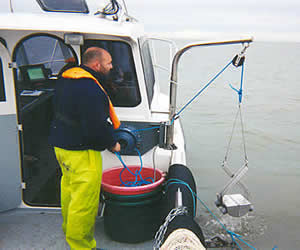
Operation of a Van-Veen grab for monitoring
seabed material
Surveys are being undertaken annually
both outside and inside the reefed area. Monitoring studies are
extended to the north and south of the reefed area, to provide control
data over 40 km of coastline from Cromer at the northern end, to
Caister-on-Sea to the south.
Positive benefits have been found in
terms of increased populations of juvenile shrimp, in the protected
bays that have developed behind the reefs. Adult shrimp are highly
mobile and juveniles recruited from the inter-tidal zone benefit
the inshore trawl fisheries over a very large area
|
|

Rock reefs at Sea Palling
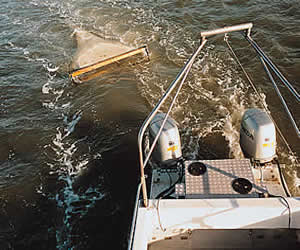
In addition surveying and sampling seabed material
to assess localised changes, the program has monitored shrimp
and ground fish populations. This particular length of coast supports
an important inshore shrimp trawling and fishing industry, operating
out of the ports of Boston, Kings Lynn, Yarmouth and Lowestoft.
The fleets exploit stocks that exist along a relatively narrow
strip of nearshore water. Brown shrimp in particular, have juvenile
stages that congregate along the low-tide line, and forage out
onto the beaches with each rising tide. Concerns over possible
effects that the changing shoreline might have on this delicate
stage in the shrimp life cycle, emphasised the need for post scheme
monitoring.
|
